Day #1
THE DIRTY WORD: “CAN’T”
“I can’t carry all these people by myself; the burden is too heavy for me.” Numbers 11:14
DEVOTIONAL
“Can’t” has become a dirty word. We live in a culture that celebrates capability, independence, productivity, and resilience. We are supposed to figure it out, push through, keep moving, and handle what comes our way. “I can’t” can sound like weakness, failure, or an excuse.
And there are a lot of voices reinforcing that message. Pride says, “You should be able to handle this.” Fear says, “If you admit you can’t, everything might fall apart.” Control says, “If you just try harder, you can keep this from happening.” Shame says, “If people knew you were struggling, they’d think less of you.” Independence says, “You don’t need anyone.” Comparison says, “Everyone else seems to be handling this. What’s wrong with you?” Perfectionism says, “You should have figured this out by now.”
But Scripture does not treat “I can’t” as a forbidden sentence. Moses said it. Elijah said it. David said it. Job lived it. Paul described being under pressure far beyond his ability to endure. Their limitations did not disqualify them from God. Instead, their limitations exposed the limits of self-sufficiency.
There is a difference between saying “I can’t” as an excuse to avoid what God has asked you to do and saying “I can’t” as an honest recognition that you are not God. You are limited. You are human. You need help.
Maybe “can’t” is not the word you need to silence. Maybe it is the word that can finally tell the truth. Maybe it is the word to help you see you’re alone.
REFLECT
- Which voice most often tells you that you should be able to handle everything yourself?
- What would it mean to let “I can’t” be an honest statement of your limits rather than a statement about your worth?
PRAYER
God, help me recognize the voices that tell me I should be able to do everything myself. Give me freedom to acknowledge my limits without shame. Remind me that being human and needing help does not make me less loved by You. Amen.
Day #2 | WHEN YOU’VE HAD ENOUGH
“I have had enough, Lord.” 1 Kings 19:4
DEVOTIONAL
Elijah's story is a reminder that sometimes “I can’t” comes after a long season of “I can.” He had been stacking wins. He stood up to an evil king. He survived in the wilderness. He participated in miracles. He confronted 450 prophets of Baal. He announced the coming rain. He even outran a chariot. Then Jezebel threatened his life, and Elijah ran. He felt all alone. He traveled into the wilderness, sat down under a broom bush, and finally said, “I have had enough, Lord.” Then he lay down and slept.
God’s response is remarkably tender. God did not lecture Elijah about his lack of faith. He did not tell him to get back out there and try harder. He let him sleep. An angel brought food and water. Elijah rested and ate. Then God met him again—not with condemnation, but with His presence, perspective, and a whisper.
Perhaps the most striking words come when God tells Elijah, “The journey is too much for you.” Sometimes the journey really is too much for us. That is not a moral failure. It is a reminder that we were never meant to be our own source of strength.
If you are exhausted today, maybe you do not need another voice telling you to try harder. Maybe you need to hear that God sees you, knows your limits, and is willing to meet you there.
REFLECT
- Where have you been saying, “I’ve had enough,” even if you haven’t said it out loud?
- What might it look like to receive God’s care instead of immediately demanding more from yourself?
PRAYER
God, You know when I have reached my limit. Meet me there with Your presence and care. Give me permission to rest, receive, and be honest about what is too much for me. Amen.
Day #3 | THE STRENGTH TO REACH OUT
“But this happened that we might not rely on ourselves but on God.” 2 Corinthians 1:9
DEVOTIONAL
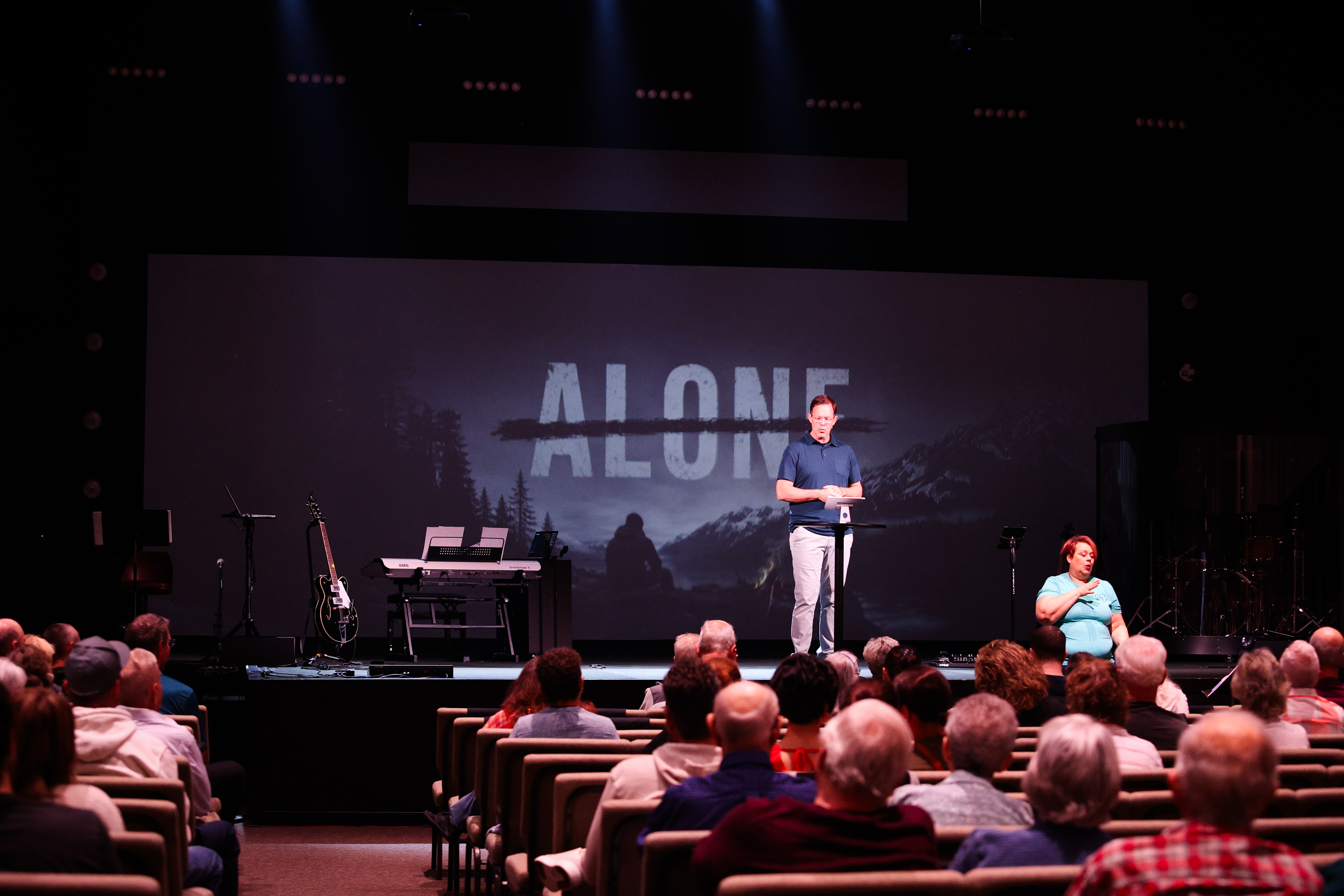
On the series Alone, the people who reach for the satellite phone are not necessarily the least capable contestants. They are often skilled, experienced, resourceful people who have simply reached a point where their resources are no longer enough. The decision to reach out can actually be a profound act of strength.
We see something similar throughout Scripture. Moses needed seventy elders to help carry the burden. David needed a hiding place and defense outside himself. Jeremiah needed God’s word to sustain him when his own resources were exhausted. Paul and his companions reached a point where they felt they were under pressure far beyond their ability to endure.
The Christian life was never designed to be a solo survival competition. God often provides what we need through other people. Sometimes the help looks like a friend who listens. Sometimes it is a pastor who walks with us. Sometimes it is a counselor, doctor, therapist, or another trained professional. Sometimes it is simply someone who sits beside us and refuses to let us walk through a difficult season alone.
We often imagine that strength means needing no one. But there is another kind of strength: the courage to tell the truth, the humility to ask for help, and the wisdom to receive what God provides through others.
You may be strong and still need help. You may be competent and still reach your limit. You may have faith and still need someone to walk with you. Reaching out is not always a sign that you are falling apart. Sometimes it is the way God helps you keep going.
REFLECT
- Who is someone safe you could reach toward when life becomes heavy?
- Is there a kind of help you have been reluctant to receive because you have viewed needing it as weakness?
PRAYER
God, give me the humility and courage to reach out when I need help. Thank You for the people and resources You place around me. Help me receive them as gifts rather than seeing them as evidence of weakness. Amen.
Day#4 | BLESSED AT THE END OF YOUR ROPE
“Blessed are the poor in spirit, for theirs is the kingdom of heaven.” Matthew 5:3
DEVOTIONAL
When Jesus began the Sermon on the Mount, He did something surprising. He called people blessed who knew they were spiritually poor. The Message puts it this way: “You’re blessed when you’re at the end of your rope. With less of you there is more of God and his rule.”
Jesus is not celebrating helplessness for its own sake. He is describing people who recognize that they do not have everything they need within themselves. They know they need mercy. They need healing. They need comfort. They need forgiveness. They need help.
Again and again, Jesus moved toward people who were willing to admit their need. The sick knew they needed healing. The hungry needed food. The grieving needed comfort. The sinners needed mercy. The desperate needed help. The disciples eventually discovered that they could not do it on their own.
There is a strange freedom in reaching this place. “I can't” can become the doorway through which we discover, “He can.” Less self-sufficiency can mean more room for God. Less pretending can mean more honesty. Less isolation can mean more community. Less control can mean more trust.
Your need does not disqualify you from God. It may be the very place where you become most aware of His presence.
REFLECT
- What need have you been trying to hide, minimize, or solve entirely on your own?
- Where might acknowledging your need create more room for God in your life?
PRAYER
Jesus, thank You that I do not have to pretend I have everything I need. Meet me in my spiritual poverty and teach me to receive Your mercy, grace, help, and presence. May my “I can’t” make room for more of You. Amen.
Day #5 | HE CAN
“Let us then approach God’s throne of grace with confidence, so that we may receive mercy and find grace to help us in our time of need.” Hebrews 4:16
DEVOTIONAL
There is a point where “I can't” can become more than an admission of limitation. It can become an invitation: “He can.” I can't fix everything. I can't control everything. I can't heal myself by sheer willpower. But I can bring what I cannot do to Jesus.
One of the words the Gospels use for Jesus’ healing work is therapeúō. It means to serve, help, heal, cure, or restore to health. It is the word from which we get therapy. Jesus was not a therapist in the modern sense, but He repeatedly moved toward wounded people, attended to them, restored them, and made them whole. He was, in a profound sense, a Wonderful Counselor.
That means you do not have to hide your need from Him. Bring the fear. Bring the grief. Bring the anger. Bring the confusion. Bring the questions. Bring the loneliness. Bring the parts of yourself you wish were different. Jesus already knows.
Those aren't the final words. God gets the final word. “I can't” gets us to God. So today, say it honestly: I can't. And then take the next step: I can't, so I'm tapping in. I can't. He can. I think I'll let Him.
REFLECT
- What is one thing you need to stop carrying by yourself and bring honestly to Jesus?
- What would it look like today to move from “I can't” to “He can”?
PRAYER
Jesus, thank You that You understand my weakness and meet me with mercy and grace. I bring You what I cannot fix, control, understand, or carry. Help me trust You, receive Your help, and take the next faithful step.
This devotional was created with the assistance of ChatGPT, drawing from and expanding upon teaching content from JaxNaz Church.